
Nature-Based Tourism

Dr. Sandra De Urioste-Stone, Program Leader
Tourism plays a vital role in the culture, quality of place, and economic development of Maine’s rural communities, as well as in the overall economy of the state. Tourism in Maine provides economic and non-economic values to its citizens, including nature conservation, cultural heritage maintenance and pride, and infrastructure and facility improvement. Maine’s outstanding tourism assets, along with the diversity of outdoor recreation opportunities, attract millions of visitors annually to and within Maine. Challenges to capturing growth opportunities relate to changes in visitor travel behavior, economic crises, limited tourism planning, and changing environmental conditions. By regularly gathering, analyzing, and communicating information about the trends and factors that influence tourism development in Maine we expect to increase the efficiency of and opportunities for Maine’s tourism industry.
The mission of the Maine-based Tourism Program is to conduct collaborative research, education, and outreach that promote sustainable tourism in Maine. Efforts to support this mission include increasing the efficiency and opportunities for Maine’s tourism industry by regularly gathering, analyzing, and communicating information about the economic impact and trends of tourism in Maine; promoting the development and enhancement of tourism destinations by understanding the social, cultural, and economic factors that facilitate and limit local tourism in Maine communities and their potential vulnerabilities due to radical weather cycles and economic trends; and promoting environmental stewardship of tourism in Maine by understanding and managing for the environmental effects of new and existing tourism opportunities.
Research Outputs
Drivers of Climate Change Risk Perceptions among Diverse Forest Stakeholders in Maine, USA
Climate change is impacting forest ecosystems, which support key ecosystem services and the general well-being of natural resource-dependent communities in Northeastern, USA. Understanding the determinants of climate change risk perceptions among forest resource stakeholders is critical to eliciting broad support for adaptation.
Alyssa Soucy, Sandra De Urioste-Stone, Parinaz Rahimzadeh-Bajgiran & Aaron Weiskittel (2021) Drivers of Climate Change Risk Perceptions among Diverse Forest Stakeholders in Maine, USA, Society & Natural Resources, DOI: 10.1080/08941920.2021.1991066l
Forestry Professionals’ Perceptions of Climate Change Impacts on the Forest Industry in Maine, USA
“Understanding perceptions of climate change impacts is critical to supporting the use of adaptation strategies, informing future research, and supporting decision-making.” Read more in this article by UMaine CRSF-affiliated researchers Alyssa Soucy, Sandra De Urioste-Stone, Parinez Rahimzadeh-Bajgiran, Aaron Weiskittel, & Bridie McGreavy.
Stakeholder Engagement–Industry Subsector Analysis
Sandra De Urioste-Stone, Aaron Weiskittel, Linda Silka, Jane Haskell, Brooke Hafford
MacDonald, Lydia Horne, Hope Kohtala, Nathaniel Burke, Asha DiMatteo-LePappe
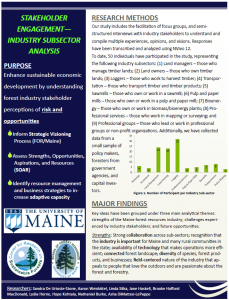
This study was designed to enhance sustainable economic development by understanding forest industry stakeholder perceptions of risk and opportunities to inform the strategic visioning process (FOR/Maine); to assess strengths, opportunities, aspirations, and resources (SOAR); and to identify resource management and business strategies to increase adaptive capacity. Going forward, UMaine researchers will develop a socioecological framework to assess the resilience of forest socioecosystems in Northern Maine to climate change. The research—to be conducted in collaboration with forest industry stakeholders—will explore the impacts of climate variability on land management and land cover using multiple research methods from the social and biophysical sciences.
Understanding Visitor Perceptions about the Impacts of Climate Change to Tourism Destinations in Maine
Sandra De Urioste-Stone
Climate change is one of the most pressing global environmental issues facing the world today and one that has major social, economic and environmental repercussions. Among all economic sectors, tourism is considered one of the most vulnerable industries to climate change due to its frequent reliance on natural resources as primary assets. In spite of this, research on the potential effects of climate change on tourism destinations remains scarce. A comparative case study was conducted in two Maine tourism destinations to understand (1) visitor perceptions about the impacts of climate change on tourism, (2) visitor risk perceptions associated with climate change, and (3) potential travel substitution strategies in response to changing climatic conditions.
Analyzing the Economic Impact of Tourism in Maine
Sandra De Urioste-Stone, Caroline Noblet, and Todd Gabe
The travel and tourism industry plays a key role in Maine’s economy, and the economic development of many communities in the state. By most measures, tourism is considered one of the largest industries in the state. In 2012, the industry generated over 20% of the state’s jobs and accounted for an estimated 17% of state tax revenue. Limited information exists on the economic activity generated by tourism in Maine. This study intends to contribute to the ongoing efforts by the Maine Office of Tourism to estimate the economic impact of the industry. The study includes two phases: (1) a pilot visitor survey (June 2014 – April 2015) to establish an effective and reliable methodology; and (2) a mixed-mode visitor survey (intercept and online) is being conducted in the state to understand travel behavior and spending.